Bangladesh is a river-rich, deltaic nation that experiences copious amounts of rainfall, particularly during the monsoon season. Despite this yearly blessing, population increase, excessive groundwater extraction, and ineffective water management continue to cause water scarcity in many areas during dry months. Rainwater harvesting (RWH) provides a decentralized, sustainable way to supplement fresh water sources for communal, agricultural, and residential uses.
WHAT IS RAINWATER HARVESTING?
The idea of gathering and utilizing precipitation, or rainwater, from a catchment surface is known as rainwater harvesting. Rainwater collection is not a novel technique. It continues to be an effective method of capturing water and has been used for thousands of years. It can be utilized for a variety of purposes if properly developed, such as: Use at home, in clinics, schools, and other public facilities, forestry, agriculture, animal care, erosion control, aquifer replenishment, flood control, etc.
WHY RAINWATER HARVESTING MATTERS IN BANGLADESH?
Bangladesh’s climate is defined by a distinct wet season (June to September) and a dry season during which groundwater levels drop, and surface water sources diminish. Rainwater collection offers a comparatively pure water source that can lessen reliance on tainted resources and promote year-round water security. Rainwater collection and storage can help close this seasonal gap.
First of all, contamination of groundwater is a serious issue. Tube-well water in many parts of Bangladesh is contaminated with arsenic, and storms and rising sea levels cause saline intrusion in coastal areas. When collected and kept appropriately, rainwater offers a safer substitute for household and drinking water.
Second, excessive groundwater extraction for domestic, industrial, and agricultural purposes has caused water tables to drop, particularly in drought-prone areas like the Barind Tract and urban centers like Dhaka. Rainwater collection helps preserve natural balance and lessens reliance on groundwater.
Thirdly, the effects of climate change-such as erratic rainfall, protracted droughts, floods and cyclones-have made water insecurity worse. By collecting extra rain during monsoon seasons for use during dry seasons and emergencies, rainwater harvesting improves resilience.
Lastly, rainwater collection is an economical and sustainable alternative. It lessens the strain on centralized water delivery systems, needs comparatively basic technology, and can be applied at the home and municipal levels.
BASIC PRINCIPLES OF RAINWATER HARVESTING
Rainwater harvesting involves capturing precipitation at the point where it falls and storing it for later use. The process generally includes:
- Catchment: Surface where rainwater lands (e.g., roofs).
- Conveyance: Gutters and pipes that carry the rainwater.
- Storage: Tanks, barrels, or ponds where water is held.
- Treatment (Optional but recommended): Filtering and disinfecting collected water to improve quality.
COMMON TECHNIQUES USED IN BANGLADESH
In practice rainwater harvesting is addressed in two main categories, namely as-
- Domestic Rainwater Harvesting and
- Rainwater Harvesting for Agricultural and Livestock Purposes (ARWH)
1.DOMESTIC RAINWATER HARVESTING
Water harvesting for domestic usage at the household level is known as DWH. Simple, low-tech methods of collecting water from conventional roof catchments, including thatched roofs, can be used, as can well-built roof catchments with gutters, downspouts, pipelines, and water collection tanks.
COMPONENTS OF DOMESTIC RAINWATER HARVESTING(DRWH)
The main components for rainwater harvesting are-
- The catchment system
- The conveyance system
- The storage system
- Water treatment/filtration system
- Distribution system
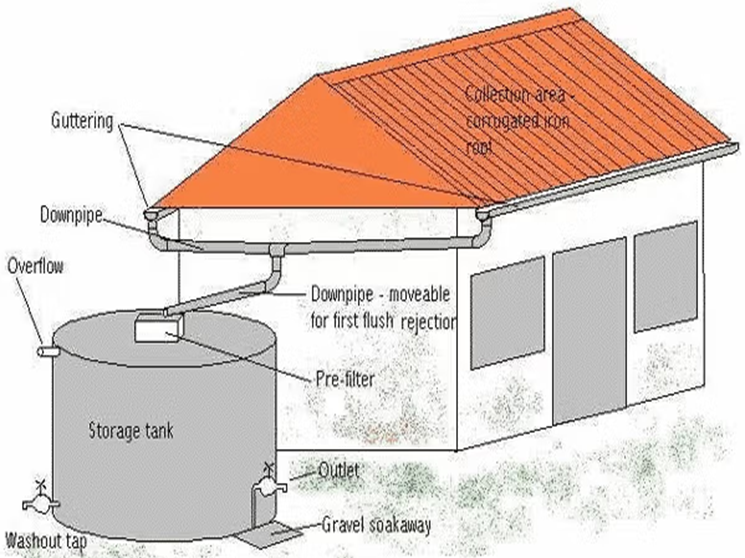
Figure: Domestic rainwater harvesting
2. CATCHMENT SYSTEM
In DRWH, the catchment system is the surface area that receives rainfall and is made available for collection. This might be the roof or any surface like concrete, plastic sheeting, or even clothing material. There are several types of catchment system such as-
- Ground catchment– Rainfall-related surface runoff can be
gathered and redirected into a storage tank
- Rooftop Rainwater Harvesting– Rainwater collection from
rooftops is the most popular domestic technique. Water is directed into concrete, plastic, or metal storage tanks or barrels via gutters and downpipes. Due to space constraints, this approach is particularly helpful in metropolitan and peri-urban regions. Simple filters and appropriate first-flush diverters aid in clearing debris and enhancing water quality.
3. CONVEYANCE (DELIVERY) SYSTEM:
Conveyance (delivery) system, as the name indicates, is the part of the water harvesting system that carries/transmits the water from the catchment area (the roof) to where the water is to be collected. The conveyance system consists of-
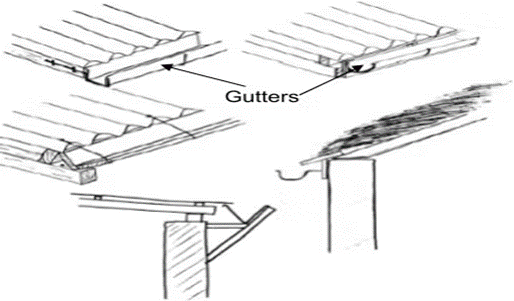
- Guttering-The rooftop channel that collects water from the roof and directs it through the downpipe.
- Down pipe- The pipe that transports rainwater to a collection vessel or the ground from the roof gutter
The Guttering can be made of- Iron sheet, Plastic materials such as PVC, Locally available materials such as bamboo trees, and wooden material.
4. STORAGE SYSTEM
There are two different categories of storage systems for rainwater harvesting-
- Above-ground tanks- Above-ground tanks are easier to build
and maintain. This can be made from plastic, wood, metal, fibreglass, bricks or masonry, ferro-cement, and concrete
- Underground tanks- Underground tanks help protect stored
water from evaporation and contamination. It is usually made of Concrete, or masonry, Ferro-cement tanks. The tank structure should be designed in such a way that the walls are capable of standing/resisting soil and water pressure from outside the walls when the tank is empty
5. DISTRIBUTION SYSTEM
The usage or distribution of water gathered from household roof catchment is usually the trickiest portion that requires excellent planning before the storage tank sitting is determined. It is feasible to install a tap stand for distribution at a lower level if the storage tank is above ground. It is feasible to have a collection box and a tap at the bottom of the tank if it is only going to be used by one family. The only choice if the storage tank is entirely or partially subterranean is to have a distribution tap stand at a lower level, provided that the topography permits it.
RAINWATER HARVESTING FOR AGRICULTURAL / LIVELIHOOD PURPOSES (ARWH)
- PANS ( HAFIR DAMS)- Pans are basic earth ponds that
can be naturally occurring or intentionally created to collect surface water runoff for use in agriculture and cattle, though occasionally they are also used for human consumption.
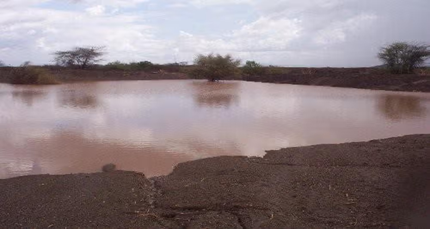
Figure-Pan full of water,Turkana,Kenya
- BIRKADES– Birkads are cement coated subterranean water storage tanks, mainly erected in Somali speaking areas of the Horn of Africa. Both Somalia and the Somali Region of Ethiopia have historically used them.
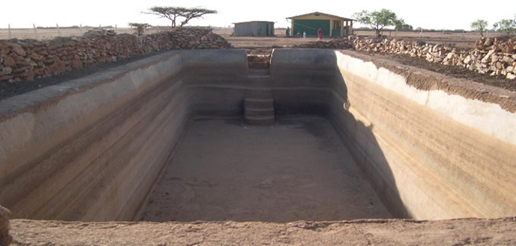
Figure-Birkade of Harshin town, Somali Region Ethiopia
- CONCRETE GROUND CATCHMENT- The concrete catchment is created such that there is around 1-2% slope towards the middle of the concrete catchment, furnished with drainage channel. The system has an underground storage tank with a corrugated iron sheet roof and a sand trap.
SOME OTHER TYPES OF RHS USED IN BANGLADESH CAN BE-
1. COMMUNITY PONDS AND RESERVOIRS Community ponds, also known as “pukur,” serve as shared catchment basins in many settlements. These ponds store extra rainwater during the monsoon and use it for residential, livestock, and agricultural purposes. Properly kept ponds also recharge groundwater and support local ecosystems.
2.PERCOLATION PITS, TRENCHES AND CHECK DAMS
Percolation pits and trenches are examples of structures that help reduce surface runoff and let precipitation soak into the aquifer for groundwater recharge. Small check dams constructed across seasonal channels promote seepage, lower flow velocity, and lessen soil erosion. These methods are especially useful in areas like the Barind Tract that are prone to drought.
3.IN-SITU SOIL WATER HARVESTING
This technique improves infiltration and soil moisture by altering the land surface to hold rainfall where it falls instead of using storage tanks. These methods can lessen erosion and improve agricultural moisture availability.
WATER TREATMENT AND QUALITY CONSIDERATIONS
Although rainwater can still carry dust, organic waste, or bird droppings from roof surfaces, it is usually cleaner than many surface sources. For home use, basic filtering systems that use charcoal, sand, and gravel in addition to sun disinfection (SODIS) or appropriate boiling can increase safety.
BENEFITS OF RAINWATER HARVESTING IN BANGLADESH
- During dry months, there is more water available.
- Lessens the strain on groundwater and lessens depletion.
- Provides for family needs, animals, and agriculture.
- Increases resistance to drought and climatic variability
- Low environmental impact and economical in a variety of situations
CHALLENGES AND OPPORTUNITIES
Despite its benefits, RWH adoption faces challenges:
- In certain rural areas, there is a lack of knowledge and technical expertise.
- The initial installation costs for larger systems.
- Need for periodic maintenance to ensure water purity.
Nonetheless, RWH initiatives are being supported by governmental and non-governmental organizations, such as BRAC, WaterAid, and the Department of Public Health Engineering, particularly in coastal and arsenic-affected areas. The mainstreaming of RWH as a component of community water management plans depends on these initiatives. Main factors that influence the amount of water to be collected are: Rainfall intensity, Catchment size, Demand, Size of conveyance, and Storage system provided.
In conclusion, rainwater collection and storage methods are becoming more widely acknowledged as viable solutions to Bangladesh’s water shortage. Rainwater collection, whether via rooftop systems, community ponds, or groundwater recharge structures, offers a workable, decentralized option that helps both families and ecosystems.
ISRAT JAHAN SHAWLY
COASTAL STUDIES & DISASTER MANAGEMENT
UNIVERSITY OF BARISAL